📄 Executive Summary
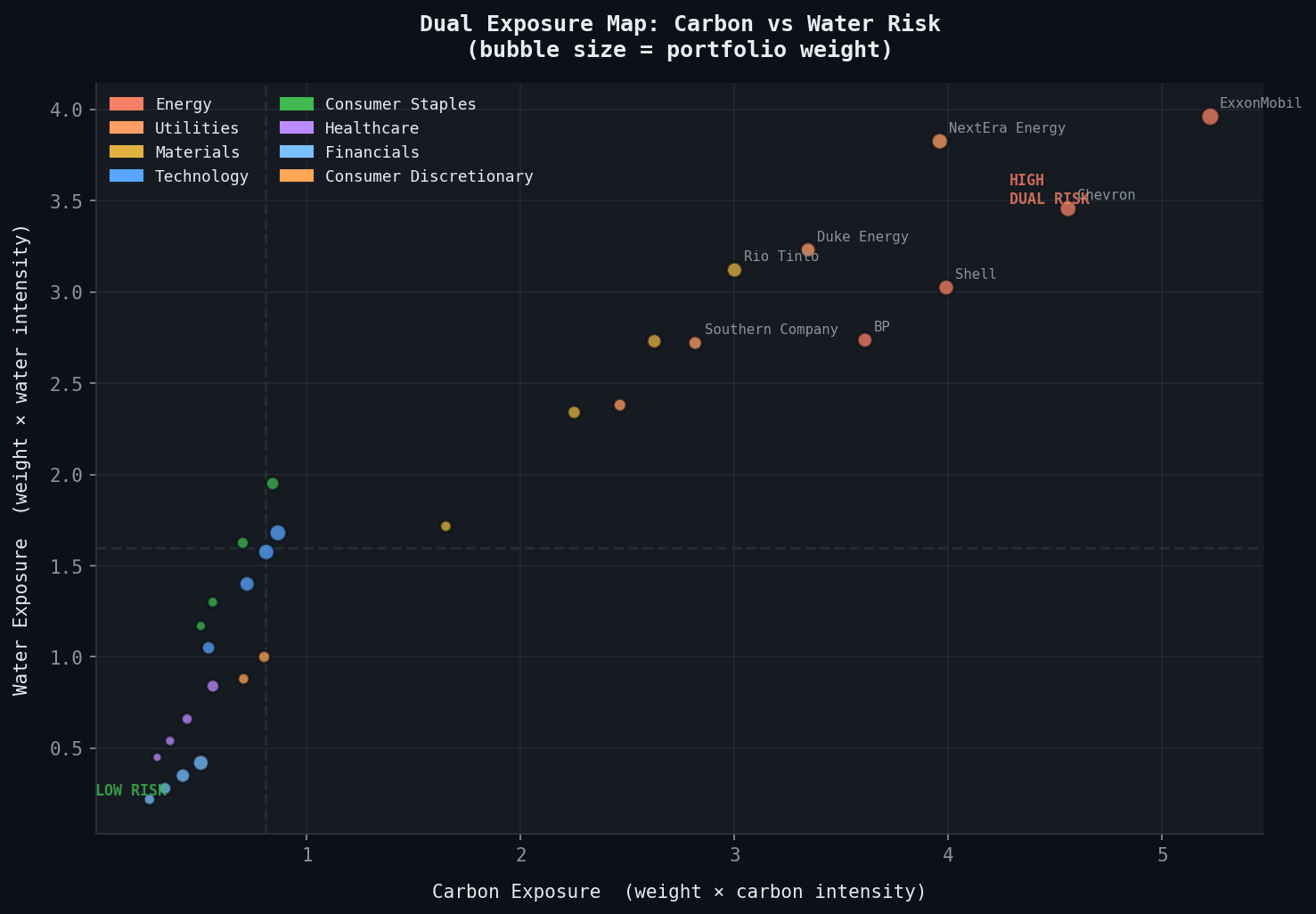
This project develops a Python-based environmental risk analytics framework to estimate an investment portfolio's exposure to carbon transition risk and water scarcity risk. While most ESG portfolio models focus primarily on carbon emissions, this analysis introduces a dual-risk framework that integrates both carbon intensity and water stress exposure.
Using portfolio allocation data combined with sector-level environmental intensity metrics, the model identifies which sectors and companies contribute most to sustainability-related risk and evaluates how portfolio rebalancing can reduce environmental exposure.
The analysis highlights that water-related risks are often underrepresented in traditional ESG frameworks, despite being critical for industries such as beverages, agriculture, utilities, and semiconductors.
The project demonstrates how data analytics and environmental metrics can be integrated into portfolio risk analysis to support more sustainable and resilient investment strategies.
💧🌿 Water & Carbon Risk Analytics for Sustainable Investment Portfolios
A Python-based ESG analytics project that estimates an investment portfolio's exposure to climate transition risk and water scarcity risk.
While most ESG portfolio models focus primarily on carbon emissions, this analysis introduces a dual environmental risk framework that also incorporates water stress exposure, an increasingly important sustainability risk for sectors such as beverages, agriculture, utilities, and consumer goods.📊 Project Overview
Climate change and natural resource scarcity are increasingly recognized as financial risk factors for investors and corporations. As economies transition toward lower-carbon systems and water scarcity intensifies across many regions, investors must understand how these environmental pressures affect their portfolios.
This project evaluates portfolio exposure across two environmental dimensions:
- Carbon intensity – representing climate transition risk
- Water intensity and water stress – representing resource scarcity risk
By combining portfolio allocation data with environmental intensity metrics, the analysis identifies which sectors and companies contribute most to environmental risk exposure and explores how portfolio rebalancing can reduce sustainability risk.
💧 Why Water Risk Matters
While carbon emissions dominate most ESG discussions, water scarcity represents a growing environmental and economic risk. Industries such as beverages, agriculture, semiconductors, and utilities depend heavily on reliable water resources, making them particularly vulnerable to regional water stress.
Integrating water-related metrics into portfolio analysis provides a more comprehensive view of environmental exposure and helps investors better understand sustainability risks that traditional carbon-focused frameworks may overlook.
⭐ Key Features
- Dual ESG risk framework combining carbon and water exposure
- Portfolio-level environmental risk estimation
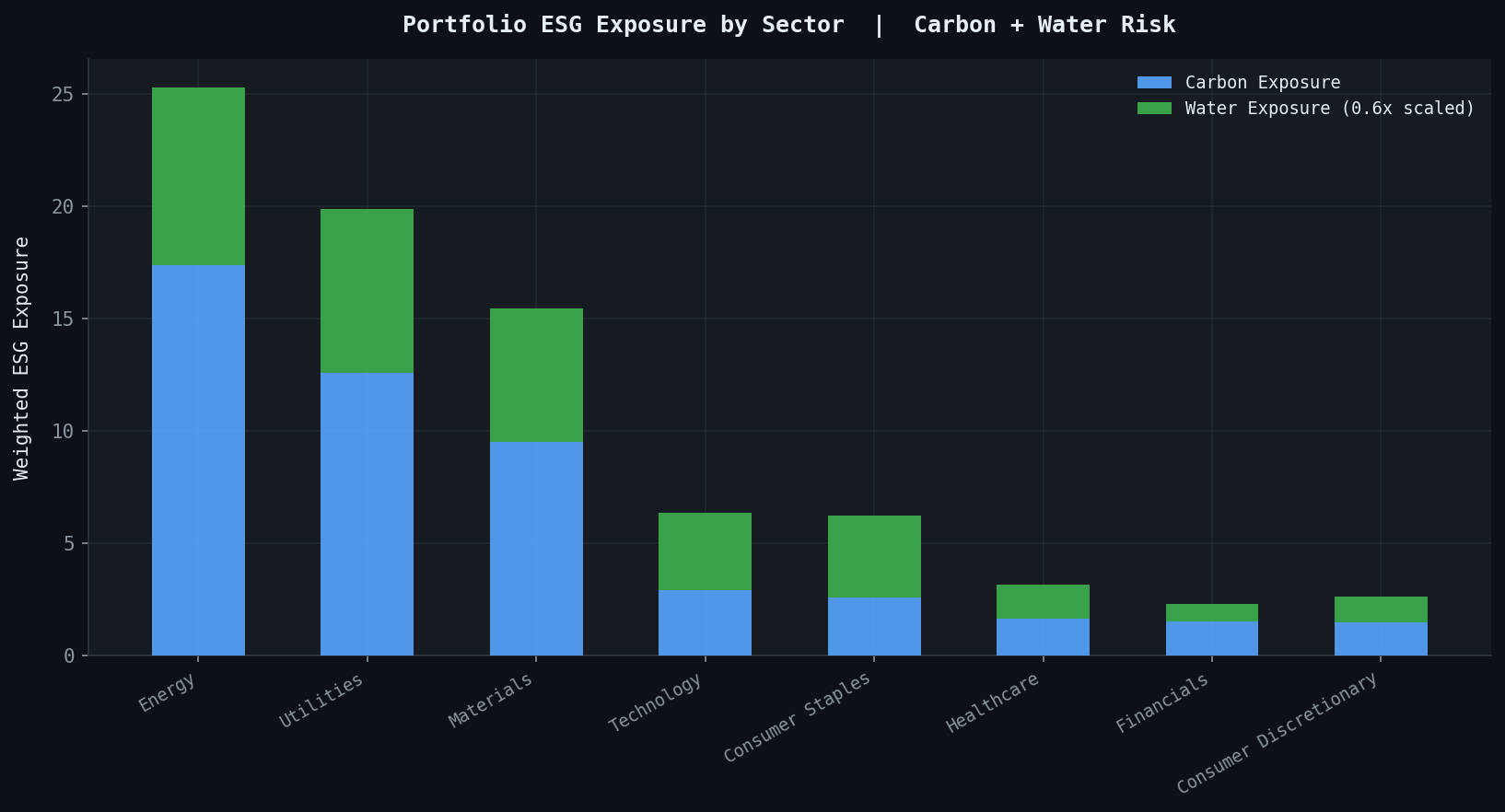
- Sector-level sustainability risk analysis
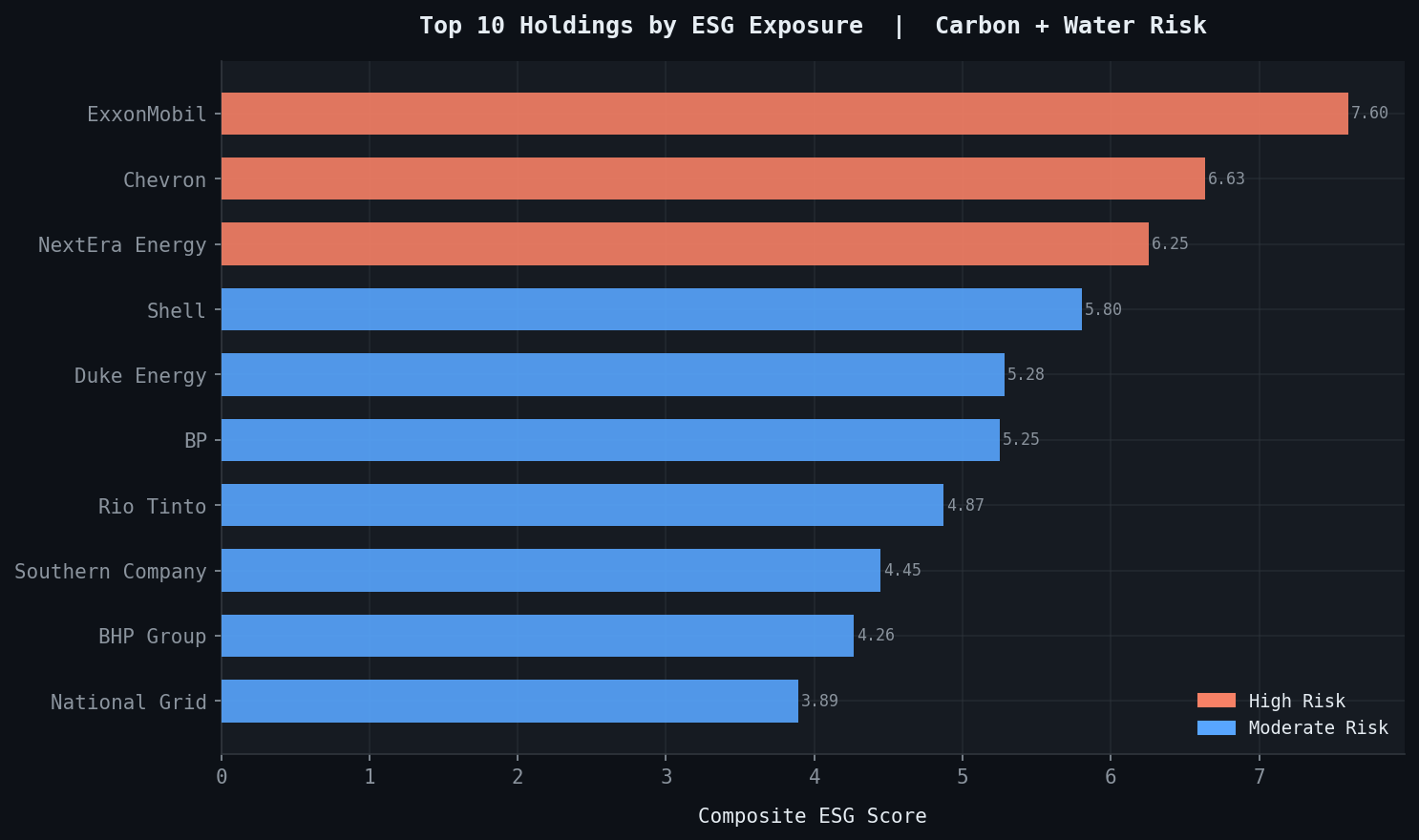
- Identification of high-risk holdings
- Environmental risk contribution analysis
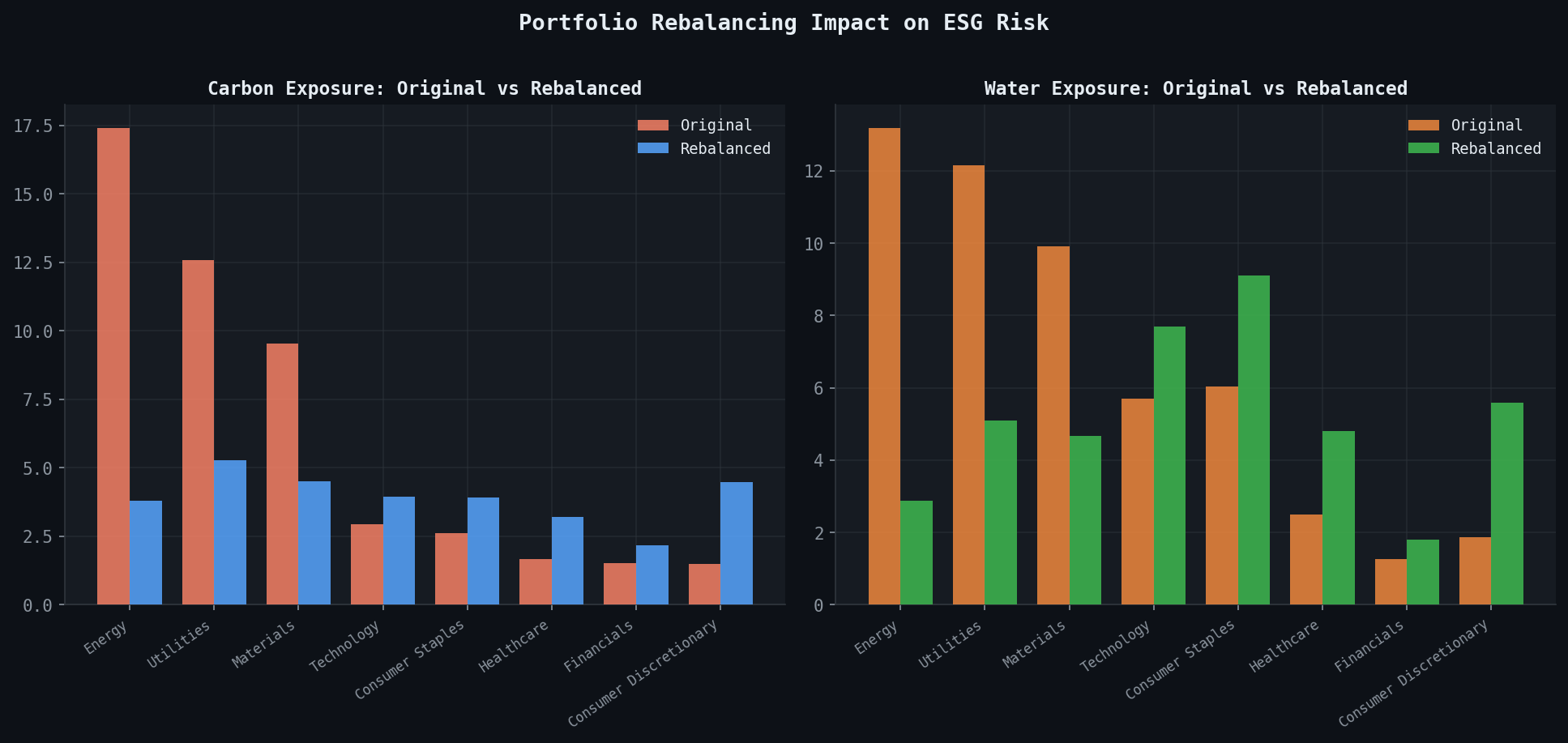
- Portfolio rebalancing scenario simulation
- Environmental cost modelling under carbon and water pricing scenarios
- Multiple data visualizations supporting sustainability insights
🎯 Project Objectives
- Estimate carbon transition risk exposure of an investment portfolio
- Measure water stress exposure across sectors and holdings
- Identify sectors and companies contributing most to environmental risk
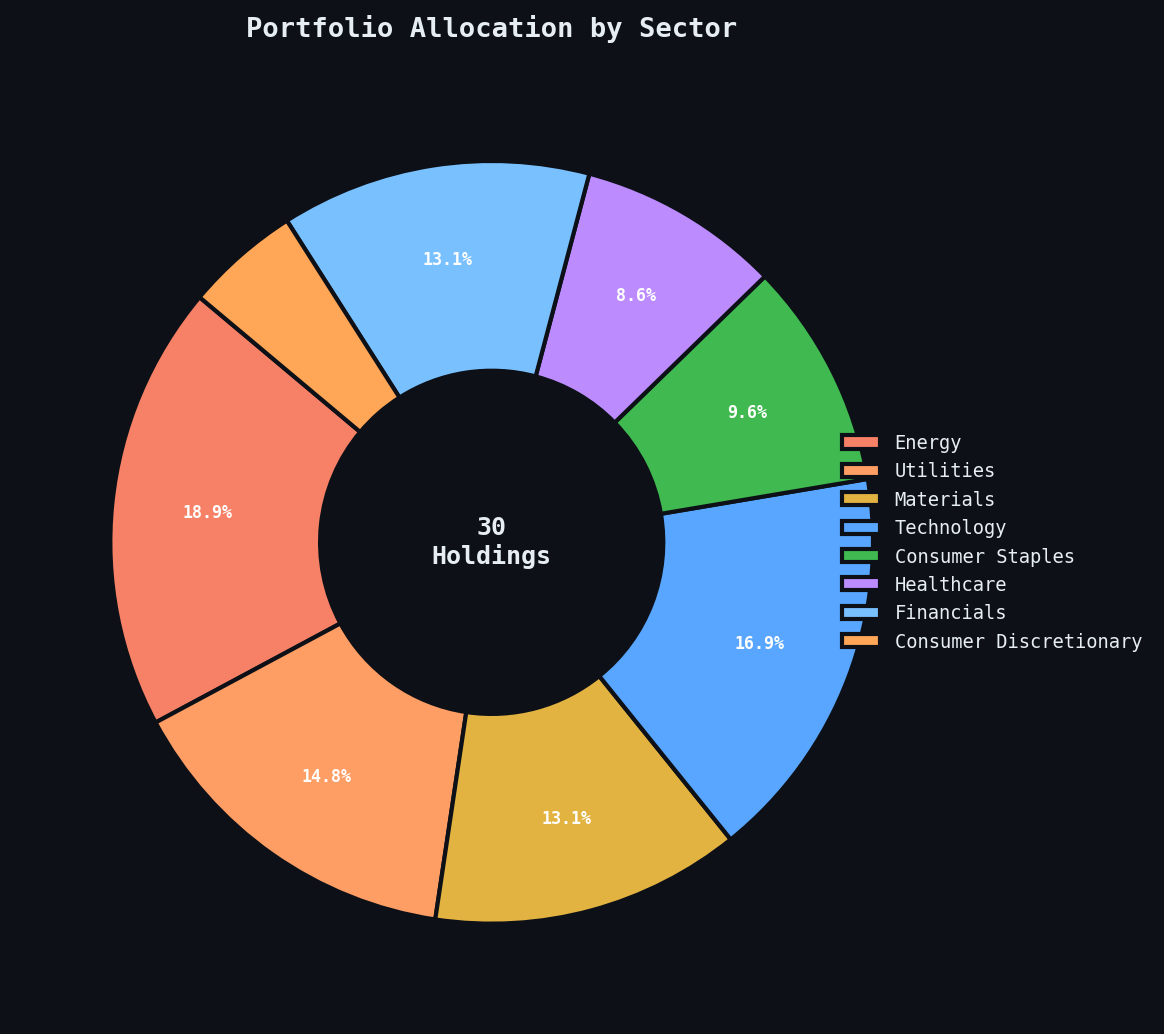
- Calculate weighted environmental exposure based on portfolio allocation
- Visualise how environmental risk is distributed across the portfolio
- Evaluate how portfolio rebalancing can reduce sustainability risk
- Demonstrate how ESG data can support more resilient investment decisions
📁 Dataset Description
Portfolio Dataset
Simulated portfolio containing 30 companies across 8 sectors.
| Column | Description |
|---|---|
| company | Company name |
| sector | Industry sector classification |
| portfolio_weight | Portfolio allocation weight |
Sector Risk Dataset
Sector-level intensity metrics used as proxies for exposure.
| Column | Description |
|---|---|
| sector | Industry sector |
| carbon_intensity | Estimated sector carbon intensity |
| water_intensity | Estimated sector water intensity |
Water Stress Dataset
Regional water scarcity indicators used to approximate geographic water risk exposure.
| Column | Description |
|---|---|
| region | Operating region |
| water_stress_index | Regional water scarcity score |
Water stress indicators are conceptually based on methodologies developed by the World Resources Institute Aqueduct Water Risk Atlas, a widely used global water risk assessment framework.
Carbon intensity assumptions are inspired by sector emissions insights from organizations such as the International Energy Agency and the CDP environmental disclosure platform.
🔬 Methodology
- Load portfolio, sector intensity, and water stress datasets
- Merge portfolio holdings with environmental intensity metrics
- Calculate weighted carbon and water exposure for each company
- Aggregate environmental exposure by company and sector
- Visualize portfolio sustainability risk distribution
- Perform scenario analysis through portfolio rebalancing
📐 Key Formulas
carbon_exposure = portfolio_weight × carbon_intensity
water_exposure = portfolio_weight × water_intensity × water_stress_index
composite_esg = carbon_exposure + (0.6 × water_exposure)
carbon_cost = carbon_exposure × carbon_price
water_cost = water_exposure × water_price
risk_score = (0.7 × carbon_exposure) + (0.3 × water_exposure)
📈 Visualizations
🛠️ Tools & Technologies
📂 Project Structure
water-carbon-risk-portfolio-analysis
│
├── data
│   ├── portfolio_data.csv
│   ├── sector_risk.csv
│   └── water_stress.csv
│
├── notebook
│   └── esg_portfolio_analysis.ipynb
│
├── images
│   ├── sector_exposure_chart.png
│   ├── portfolio_allocation.png
│   ├── top_holdings.png
│   ├── rebalancing_comparison.png
│   ├── carbon_water_scatter.png
│   ├── risk_heatmap.png
│   └── risk_contribution.png
│
├── index.html
└── README.md
💡 Key Insights
- Environmental exposure is often concentrated in a few carbon- and water-intensive sectors
- Carbon-focused ESG models may overlook important water-related risks
- Water-intensive industries such as beverages, agriculture, and utilities face significant operational risks under water scarcity
- Portfolio rebalancing toward lower-intensity sectors can meaningfully reduce environmental risk exposure
- Integrating multiple environmental metrics enables more robust ESG investment analysis
- Integrating company-level emissions data
- Incorporating real water stress datasets such as the Aqueduct Water Risk Atlas
- Building interactive dashboards using Plotly or Power BI
- Expanding the model to include biodiversity and supply chain risk
- Implementing portfolio optimization with ESG constraints
The analysis highlights several sustainability insights:
🚀 Future Improvements
Possible extensions include:
🎓 Conclusion
This project demonstrates how carbon and water risk data can be integrated into portfolio analytics to identify sustainability-related exposures. The analysis highlights the importance of multi-dimensional ESG frameworks that extend beyond carbon emissions to incorporate broader resource risks.
👨💻 Author
Arnav Verma | MSc Sustainability Transformation, ESSEC Business School